Home Treatments Learn Case Studies The Process About Book Consultation (702) 852-2829

Gum disease.

What a pocket is, why the millimetres matter, and which cleaning goes with which number.

Your gum is not glued to your tooth. There is a small space where they meet. We measure that space with a tiny ruler. The number is how deep it is, in millimetres.

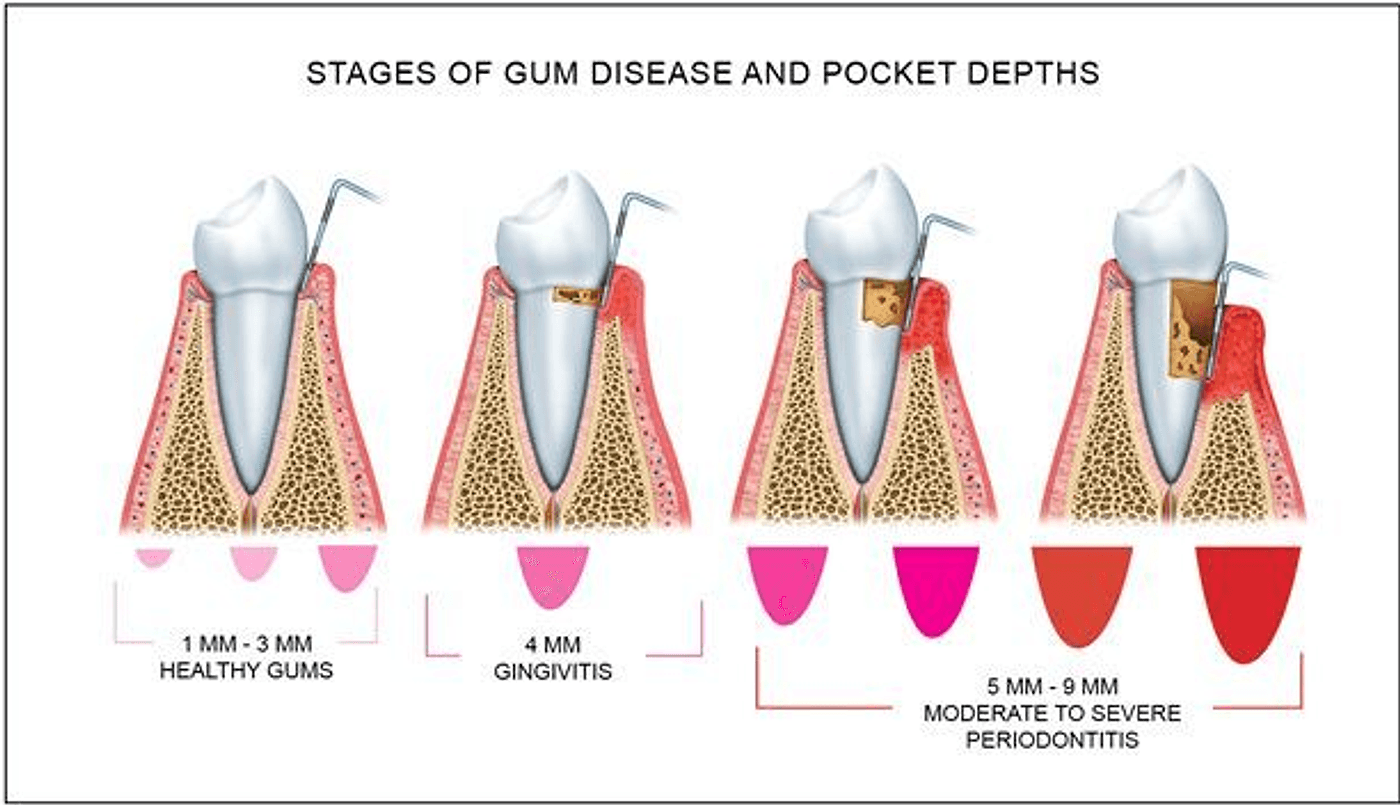
A healthy space is 1 to 3mm. When gums get sick, the space gets deeper. A deep one is called a pocket. That is the number your dentist calls out at your exam.

Cross-section of four teeth. In the first two the bone sits high against the tooth. In the last two the bone has dropped away and hard deposits sit deep against the root.
Watch the bone, not the number. The speckled part is bone. In the first two it sits high, so nothing is lost. In the last two it has pulled away from the root. Bone does not grow back.

Your brush only gets 2mm down.

Floss gets about 3mm. Past that, nothing you own reaches the bottom. So a deep pocket is not just a bigger number. It is a spot you cannot clean, no matter how hard you try. That is the whole problem.

What each number means

Pocket depth, what it means, and the cleaning that goes with it
Measurement 1 to 3mm no bleeding Healthy Nothing to fix 1 to 3mm bleeds Sore gums Reversible 4mm the tipping point Too deep to reach 5 to 6mm   Bone is going Deep cleaning 7mm and up   A lot of bone is gone Deep cleaning
What it means Your brush and floss reach the bottom. You can keep this clean yourself. The gum is puffy and bleeds. No bone is gone. This one goes back to normal. Your brush stops short of the bottom. The x-ray shows whether bone has started to go. Bacteria sit on the root where nothing you own can reach them. Teeth can get loose at this depth.
The cleaning A regular cleaning. Most people get two a year. A regular cleaning. If a lot of the mouth bleeds, one deeper full-mouth cleaning first. A cleaning under the gum. What kind depends on the x-ray. A deep cleaning. You get numbed, and it is done a section at a time. A deep cleaning first. If it does not tighten up, a gum specialist.

If you had a deep cleaning, read this part

A deep cleaning is the start, not the end. Two cleanings a year is no longer enough. The bacteria grow back down into the pocket in a few months. Every time they do, a bit more bone goes, and bone does not come back.

So you come back more often, usually every three to four months. Your dentist sets the exact gap based on how your gums do. It is not an upsell. It is the thing that holds the line. People who skip it usually end up right back where they started, with less bone than before.

Sources. Gum disease is classified using the 2017 World Workshop system, co-presented by the American Academy of Periodontology and the European Federation of Periodontology: AAP, Staging and Grading Periodontitis, from Tonetti, Greenwell and Kornman, Journal of Periodontology 2018;89(Suppl 1):S159-S172. Gingivitis is a separate diagnosis from periodontitis, not a stage of it. Treatment steps, and the target of pockets at 4mm or less with no bleeding on probing, follow the EFP S3 level clinical practice guideline for stage I to III periodontitis. Maintenance intervals after treatment are individual: a 2 to 4 month recall is reasonable in moderate to advanced cases, set by risk rather than a fixed rule. Brushing and flossing reach figures are approximate and vary with technique.

Want to know your own numbers?

A full periodontal exam measures every tooth and tells you exactly where you stand.